The charm of a pre-1980s Lisbon flat — high ceilings, wooden floors, thick walls — is also the reason its wiring is expensive to change. None of the following makes a flat a bad buy. All of them are cheaper to discover before the offer than after the demolition.
Two-wire circuits without a protective conductor are common in the older stock. It is the single finding that most often turns a modest upgrade into a bigger job, because modern protection assumes an earth exists.
Runs chased into thick masonry, threaded behind skirting, or taken through the ceiling void of the flat below. What can be reused and what has to be re-run is not visible until something is opened, which is why quotes carry conditions.
Fifty years of extra sockets, an added bathroom, a kitchen rebuilt twice — each reasonable on its own, and collectively a map that nobody holds. That is the real cost driver: not the cable, but the hours spent working out what feeds what.
Renovations go wrong on order more often than on price. Electrical work has one natural moment, and it is earlier than most people schedule it.
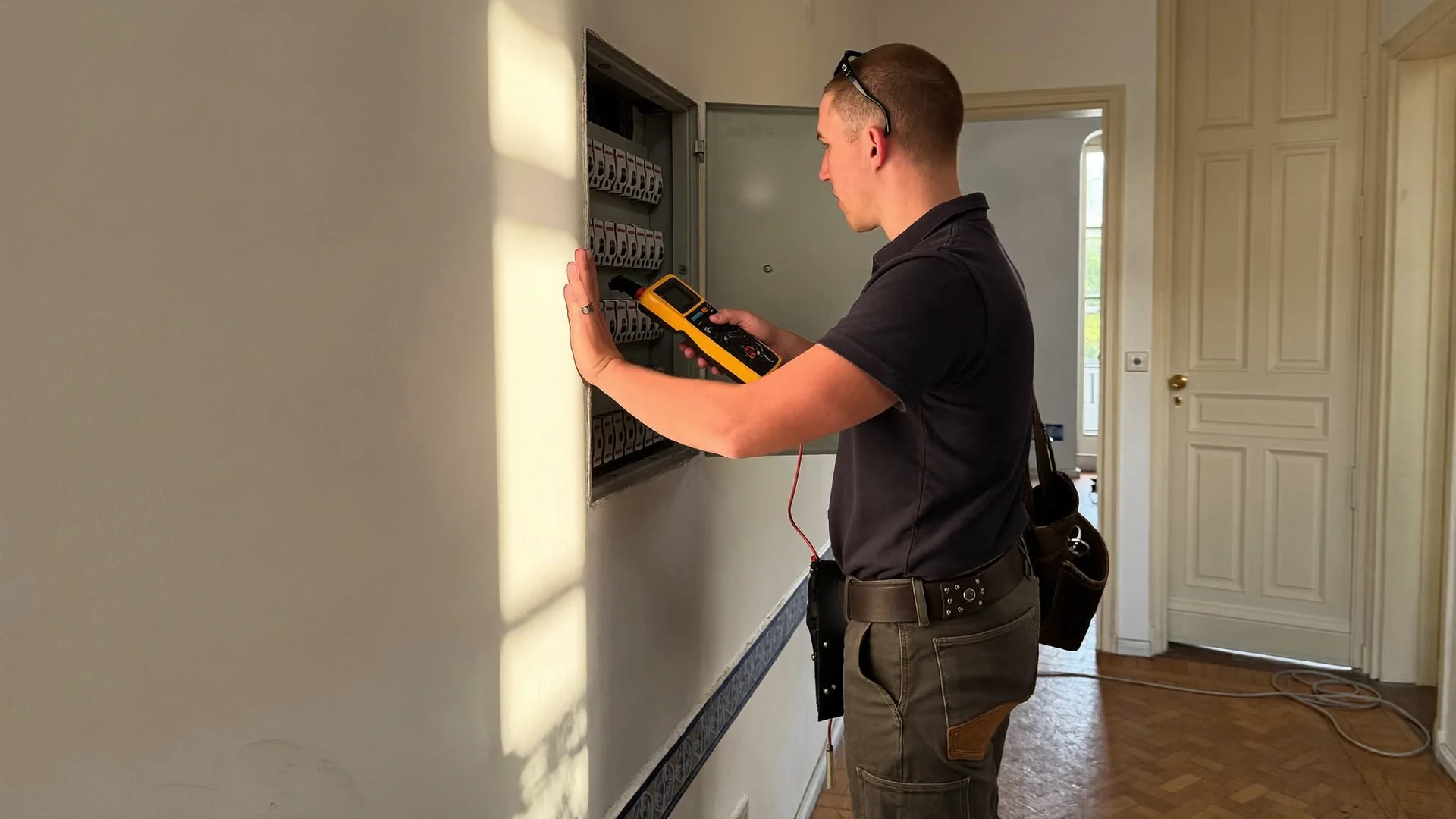
Have somebody open the board and look, ideally during the buying process. An hour here changes what the whole project is worth.
First fix happens while everything is open. Every socket you did not decide on now is a chase cut into a finished wall later.
Floor boxes, underfloor runs and anything crossing a room have exactly one window. Wooden floors in these buildings do not enjoy being lifted twice.
Appliance circuits, the hob supply and the extract all have to exist before the units are fitted. This is the deadline that slips most often.
A survey is not a quote. It is an hour spent establishing what exists, and it is the cheapest hour in the entire project.
Renovation demand concentrates in the older central parishes and in the first ring around them, plus the villa stock along the Cascais and Sintra lines where an outbuilding or a garden supply is usually part of the same project.
Related: Fuse boxCertificationPricesCascais & Estoril Em portuguêsEletricista LisboaEletricista 24 horasEletricista certificadoSubstituir o quadroPreçosAlmadaCascaisSintra
No, and assuming it does is an expensive default. Plenty of installations from the 1980s onward are sound and only need the board and the earthing brought up to date. The finding that usually forces a full rewire is the absence of a protective earth combined with cable that cannot be re-pulled through what is already there.
Often yes, and for people living in the flat it is sometimes the only workable approach. It costs more in total and it needs a plan drawn at the start, otherwise the third phase ends up undoing the first. Agree the end state before the first socket moves.
Dust, noise and channels cut into walls in every room that is touched, plus days without power on parts of the flat. In an occupied home it is genuinely unpleasant. In an empty one between owners it is straightforward and considerably cheaper.
For a small upgrade, no. For a substantial alteration, a new supply or anything the building has to accept, Portuguese practice puts a named technical professional behind it and there will be documentation. Ask early, because it affects the timetable more than the price.
It comes up constantly in these buildings, because runs genuinely do pass through it. Anything requiring access to a neighbour's ceiling needs their agreement, and getting that conversation started early is worth more than any technical decision on the list.
Yes. Modern appliances want circuits of their own and a contracted capacity that matches. Add them to the survey list at the start: deciding the electrical scope with the finished flat in mind is far cheaper than adding a circuit to a wall that has just been painted.
Two photographs — the open board and the meter cabinet — plus the year the building went up will get you a realistic first opinion on what the electrics are going to ask of your budget.
Get the wiring looked at before the walls close. It is the cheapest hour in the whole project.