Most tripping is caused by something plugged in. But a handful of signs point at the board itself, and they are worth recognising because they are the ones that do not improve on their own.
Replacing a board sounds like swapping a box. In an older Lisbon flat it is usually the moment the rest of the installation gets an opinion, which is why quotes for the same job vary so much.
A new unit protects the circuits it is connected to. If those circuits have no earth conductor — normal in the older housing stock — then modern protection cannot do half of what it is designed for, and the conversation widens whether anybody wanted it to.
In many Lisbon buildings the meter is downstairs in a communal cabinet while your board is in the hall. Anything involving the supply side or the riser means coordinating with the building, and sometimes with the network operator, which adds days rather than hours.
A straight swap is a working day with the supply down for a good part of it. If somebody works from home, or a freezer matters, that gets planned rather than discovered halfway through the morning.
The pattern follows construction dates rather than postcodes. Pre-war central parishes and the big 1960s and 1970s estates on both banks are where original boards still turn up; the 1998-onwards stock around Parque das Nações rarely has the same problem.
Related: Rewiring & renovationCertification24-hour call-outsPrices Esta página em português
Sometimes, and it is worth asking. A single failed device inside an otherwise sound modern board is a small job. A porcelain-fuse board with no residual-current protection is not repairable in any meaningful sense — you can keep it alive, but you are maintaining something that no longer does the job it exists for.
For a straightforward replacement, most of a working day. Longer if circuits have to be identified one at a time because nothing is labelled, which in an older flat is the normal case rather than the exception. Plan for the freezer and for anybody working from home.
Not for work inside your own flat. You do need to talk to them if the job touches the communal riser, the meter cabinet or anything on the landing — and it is worth asking early, because building administrators move at their own speed.
Only if the board was the fault. New protection is often more sensitive, not less, so an underlying problem in the wiring or in an appliance will show up faster afterwards, not less often. That is the device working correctly, and it is worth knowing before rather than after.
If it is going to happen anyway, an empty flat is dramatically cheaper and less disruptive than a furnished one, and it is the only moment when opening a wall costs nothing extra. Get the board looked at during the buying process rather than after the keys change hands.
You can, and people do to save money, but it moves the responsibility for the choice onto you. Most electricians would rather specify the parts they are going to sign off on, and a box bought on price alone is a poor place to have saved.
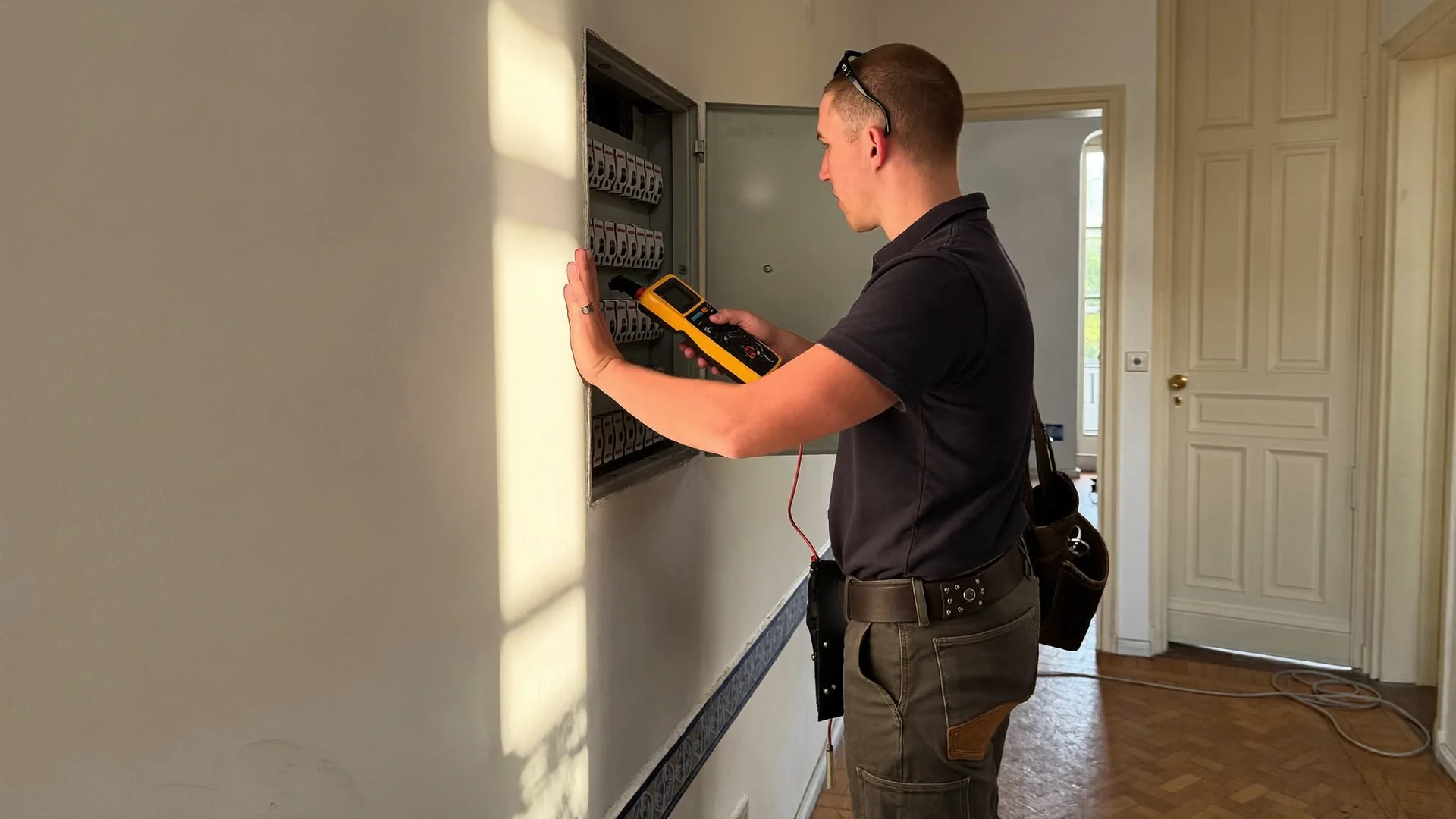
One picture of the open board — the row of switches, any labels, the make on the enclosure — lets an electrician say straight away whether this is a repair, a replacement, or a bigger conversation.
Send a photograph and the address. Somebody who does this weekly will tell you what you are looking at.