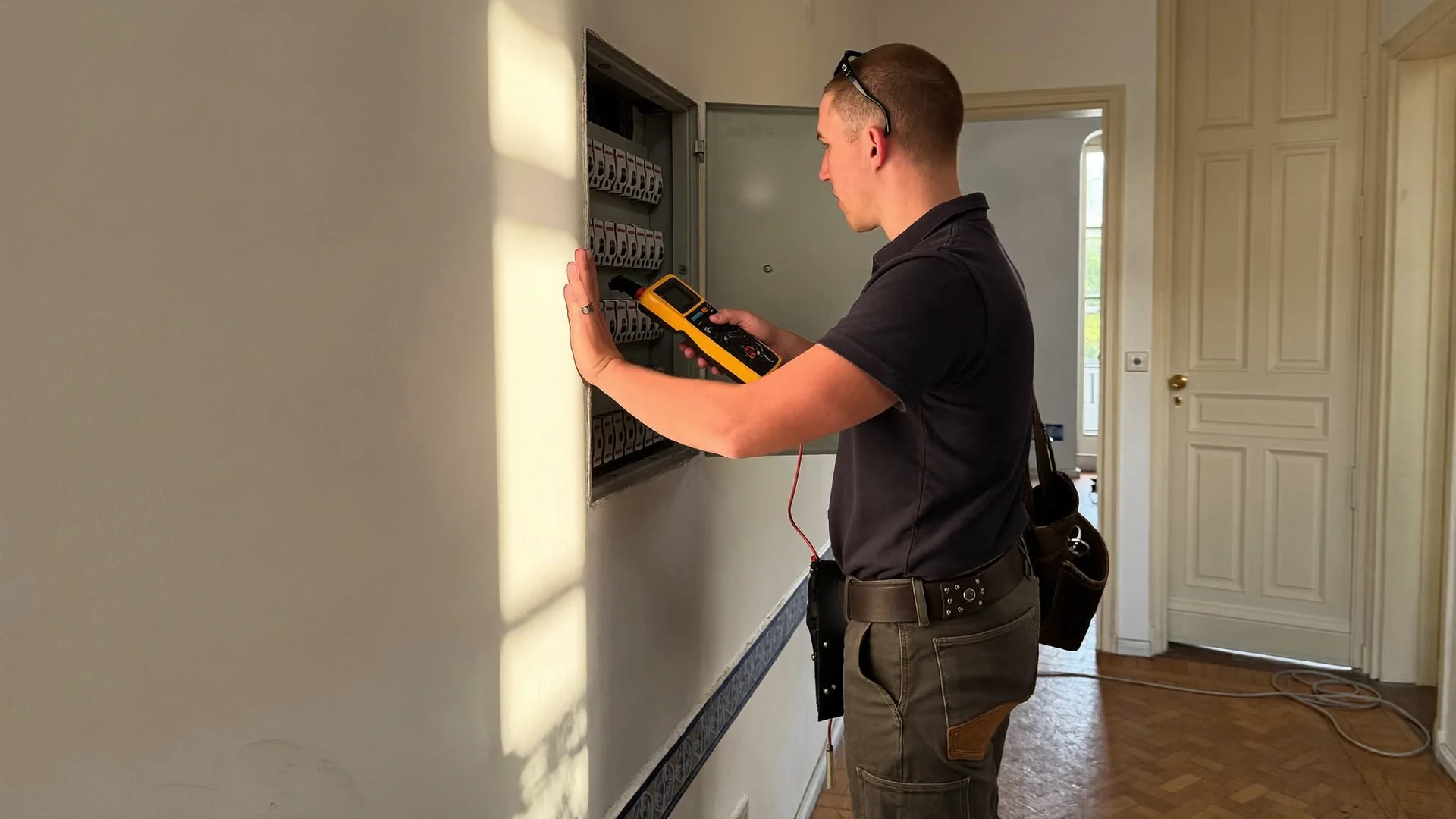
In English-speaking countries "certified electrician" usually means a person holding a trade qualification. In Portugal the weight sits on the business being entered on a register and on somebody carrying technical responsibility for the installation. They overlap, but they are not interchangeable, and the difference shows up exactly when you need a piece of paper.
Access to the activity of electrical installer in Portugal runs through national legislation — Lei 14/2015 — with the national energy directorate, DGEG, as the authority. The practical consequence for you is simple: a business doing fixed electrical installation work should be able to tell you it is registered, and give you the number.
For larger installations Portuguese practice puts a named técnico responsável behind the design or the execution. If a project, a certificate or a formal inspection is involved, that name matters more than any logo on a van, and it is the name that ends up on the document.
Separate again, and the one nobody asks about until there is smoke. Liability cover is not automatic and it is not implied by registration. Ask whether the person working in your flat carries it, and ask before rather than after.
None of these are aggressive and all of them are normal. A business that hesitates over any of them has told you something useful.
The registration question comes up hardest in two situations: an older building where the installation predates every current rule, and a sale or insurance claim where somebody wants a document. Both are common across the central Lisbon parishes and the pre-1980s blocks on the south bank.
Related: Fuse boxRewiring & renovationPrices24-hour call-outs Esta página em português
No. It is a marketing operation that matches requests with electricians, and it carries no Portuguese installer registration of any kind. Any site in this niche claiming a badge it cannot show you a number for is worth a second look.
Ask for the registration number and the exact legal name of the business, then check it against the public register held by the national energy authority. It takes a few minutes. A business that gives you both without hesitating has usually already answered the question.
For a small repair inside an existing installation, most people in Portugal call somebody they trust and never see a certificate. The moment it involves the board, a new circuit, a change of supply, an insurance claim or a sale, the paperwork stops being optional. If in doubt, treat the board as the dividing line.
A named professional who takes technical responsibility for an installation or a project — the person whose signature says the design or the execution meets the rules. On a small domestic repair you will never meet one. On a rewire, a new supply or anything the building has to accept, they are the reason the document is worth something.
It tells you the installation was documented at some point. It says nothing about what has been changed since, and in older Lisbon flats a great deal usually has. If you are buying, treat the certificate as a starting point and have somebody open the board and look, which is a far cheaper hour than the one you spend afterwards.
No, and neither can any matching service that is being honest with you. What happens here is that the requirement is passed on with your request and you are told to ask for the number yourself. The check that protects you is the one you make at your own front door.
If the job needs a registered installer and a document at the end — for an insurer, a condomínio, a sale — write that in the message. It changes who the request is worth sending to.
Describe the job and say that the paperwork matters. It goes into the brief before anybody is contacted.